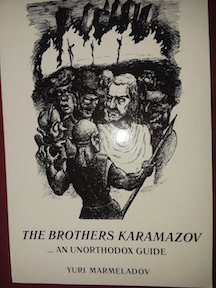
The Brothers Karamazov: an Unorthodox Guide
by Yuri Marmeladov
This edition will introduce the reader to insights on The Brothers Karamazov that are completely new and unfamiliar to established Dostoevsky scholars. Further discussion of this theme can be found in Robert Mann's ebook, available here and on Kindle: Dostoevsky: What They Don't Teach You in School.
Author: Yuri Ilyich Marmeladov
Title: The Brothers Karamazov: an Unorthodox Guide
Editor: Robert Mann
Essay following Marmeladov's text: Robert Mann
© 2015 Robert Mann
The Brothers Karamazov (Thoughts on the Novel)
by Yuri I. Marmeladov
Editors' Introduction
Shock waves rippled through the world of literary criticism in 1992 with the publication in St. Petersburg of Yuri Marmeladov's groundbreaking study of Dostoevsky, Tainyi kod Dostoevskogo (Petrovskaia Akademiia Nauk i Iskusstv). The world of literary criticism was sleeping at the time, and the shock waves were generally attributed to mysterious seismic activity in the Bering Strait. Marmeladov's book is a posthumous publication, and the world of literary criticism seems intent on burying the dissident scholar a second time. We wish to reassure the literary world that Marmeladov is already safely buried. His discoveries can now be criticized, analyzed and appropriated in piecemeal fashion mercilessly and with impunity, as is the fashion with posthumous publications. The carrion call has sounded. There is no longer any need to share any credit or honor with Marmeladov. And a good thing, too. There is too little credit to go around nowadays.
Marmeladov's book is incomplete, based on a single damaged and fragmentary manuscript which he left behind. The primary lacunae in the manuscript are a chapter devoted to Tolstoy and Leskov and an incomplete chapter or series of notes pertaining to The Brothers Karamazov. Marmeladov's widow claimed that her late husband, acting on a whim, sewed these chapters into the pocket of his sport coat and took them with him into the afterlife. Nevertheless, Marmeladov's longtime friend and student Jay MacPherson was undaunted by Julia Ilyinichna's story and perseveringly conducted groundbreaking research among present and past friends and colleagues of Yuri Marmeladov, especially in Buffalo, Brighton Beach and the environs of Leningrad's Porokhovye, one of Marmeladov's favorite haunts. MacPherson's efforts finally payed off in July, 1992, when he unearthed a manuscript which must certainly be an unposted letter to an American friend written in the early years of Marmeladov's sojourn in America, judging by conspicuous weaknesses in the author's command of English. According to MacPherson, the person who produced the manuscript refused to be identified and was reticent about his relationship to the late Marmeladov.
The newly discovered text is introduced below, unedited and unexpurgated, for the same world of literary critics who slept through the initial shock wave. We trust that the aftershock from this small edition will not disturb their slumber, measuring no more on the Richter scale than the tremors produced by the faint heartbeat of a dying firebird.
Of course, Marmeladov's letter is something quite different from a formal literary essay with all the necessary footnotes, endnotes and abeisances to all the academicians whom one respects, fears or simply counts on for a good review or for support as one climbs up the career ladder. But the letter doubtless gives us a better idea of what Marmeladov planned to include in the incomplete chapter about The Brothers Karamazov. As a preface to this most curious document, we should first summarize the chapters in Marmeladov's book which precede the incomplete notes on The Brothers Karamazov. This will spare the reader the unpleasant task of reading Marmeladov's book in its entirety. Many scholars take pride in knowing everything there is to know about Dostoevsky already. "What I don't know isn't knowledge." We envy them their unbounded erudition and only suggest that they skim through a few pages before sitting down to write their memoirs or their next book review for the Slavic and East European Journal.
Marmeladov begins his posthumous study of Dostoevsky with a brief survey of the religious and folkloric beliefs about Elijah the Prophet which were current in Dostoevsky's time and which form the backdrop for a vast network of allusions to the fiery prophet throughout much of Dostoevsky's fiction. The reader will recall from Sunday school that Elijah was given power over rainfall and rose to heaven in a whirlwind of fire on a chariot drawn by fiery horses. Christians expect Elijah to return as a harbinger of the Last Judgment — a belief which seems to echo similar messianic expectations among the Jews. When Christianity was introduced to the pagan Russians in the tenth century, Elijah gradually inherited many of the functions of the pagan thunder god Perun, doubtless due to his similar dominion over lightning, fire and rain. After the conversion to Christianity, thunder and lightning — formerly the provenance of Perun — came to be attributed to Elijah as he rumbles across the stormclouds in his fiery chariot.
Eager to incorporate indigenous Russian spiritual beliefs into the rather nationalistic fabric of his fiction, Dostoevsky elevates Elijah the Prophet to a special place of honor as a quintessential symbol of God's Judgment, of a cruel universe where sin and suffering are ever-present. Interestingly enough, Elijah is already at the thematic center of the early stories of the 1840's, including "Mister Prokharchin," The Landlady and The Little Hero (the latter work written while Dostoevsky awaited execution in the Peter-Paul Fortress).
However, in proceeding through a dozen of Dostoevsky's works, Marmeladov begins with Crime and Punishment, focussing on the assistant police superintendent Il'ia Petrovich, to whom Raskol'nikov eventually confesses. This stern and fiery-tempered policeman is portrayed with abundant imagery pertaining to thunder and lightning. His name Il'ia ('Elijah') points directly to the Biblical prophet (Il'ia-prorok), and his nickname, Porokh ('Gunpowder'), alludes to the explosions of Elijah's thunder and to the Petersburg Church of Elijah the Prophet, located at the powderworks. The novel's action covers roughly fifteen days until Raskol'nikov's confession. Because the action begins "in the beginning of July," the confession comes on or near the holiday of Elijah, July 20 (O.S.), when the Russian people always expected a thunderstorm. Before confessing, Raskol'nikov wanders around Petersburg all night during a spectacular thunderstorm beneath flashes of lightning that last nearly five seconds. Elijah's lightning serves as a frightful reminder of one's transgressions and of the hellfire which awaits lost sinners after the Last Judgment. Svidrigailov commits suicide during the thunderstorm beneath the watchtower of a fire station. The watchtower is suggestive of a divine presence with dominion over fire — God and Elijah the Prophet once again. Raskol'nikov's landlady (as Georgii Meier noted before Marmeladov) is a symbolic emanation of Raskol'nikov's conscience — of a spiritual awareness of right and wrong — as her late husband's "assessor" title hints. Her last name is Zarnitsyna, derived from zarnitsa ('sheet lightning'), suggestive of the quiet illuminations of conscience and of a close bond with the lightning-wielding prophet. Her first name, Praskov'ia, is a russified variant of Paraskeva (St. "Friday") the female saint whose Friday celebration ushered in the holiday of Elijah in late July. In Petersburg, huge throngs sometimes numbering nearly 100,000 would gather near the Church of Elijah the Prophet at the Powderworks and at the Chapel of St. Paraskeva, which stood alongside the Church of Elijah. Marmeladov proceeds to show how Dostoevsky weaves his Elijah symbolism into many of the novel's nooks and crannies, including details such as Zosimov's giving Raskol'nikov a "powder" as a remedy for his ailment. Marmeladov's observations cast much light on the various dreams and delirious visions experienced by Raskol'nikov before and after the murder.
Marmeladov then turns to The Village of Stepanchikovo and Its Inhabitants, a light, farcical work of the 1850' which has received little attention in Dostoevsky studies. This is a serious oversight, according to Marmeladov, because Stepanchikovo is the only work in which the hidden Elijah leitmotif comes out into the open clearly and explicitly. Marmeladov shows that the story is an allegorical portrayal of the struggle between God and the Devil. [Note? Marmeladov uses "allegorical" in the broadest sense, not intending to offend scholars who insist that this term be used only according to a strict, traditional catechism. If he were alive today, he would certainly apologize to all men of letters who are offended by his terminology.? The main hero, Yegor Il'ich Rostanev, is endowed with traits linking him with both God and Elijah. He is man in the likeness of God. The malicious, spiteful Foma Fomich, who lives as a sponger in Rostanev's home, is man in the likeness of the Devil. The goodhearted Yegor Il'ich meekly endures a long series of outrages from the despicable Foma before finally exploding and ejecting him from his house during a dramatic thunderstorm on the nameday of Rostanev's son Il'ia — the holiday of Elijah the Prophet. Although the denouement of many of Dostoevsky's plots comes on the background of a thunderstorm, Stepanchikovo is the only work in which the storm is attributed explicitly to Elijah.
Marmeladov argues that the enigmatic Il'ia Murin in the early story The Landlady is not a satanic figure as he tends to be viewed by many readers, but rather another incarnation of the stern prophet Elijah. The name Il'ia Murin seems to evoke associations with the epic hero Il'ia Muromets (who is possibly a secularized transformation of Elijah the Prophet) or with the village of Murino, situated on the Okhta a few miles upstream from the Church of Elijah in Petersburg. Murin looms before the story's young hero Ordynov as a symbol of God's imperfect, unjust universe filled with sin and suffering — a universe against which Ordynov rebels, much like Raskol'nikov in Crime and Punishment. Ordynov endures spiritual torment at the sight of Katerina, his beautiful young landlady who willingly and totally submits to the gruff old Murin. The landlady, in Marmeladov's view, has a spiritual significance much like that of Raskol'nikov's landlady in Crime and Punishment. She is an emanation of Ordynov's conscience or soul, that part of himself which he must surrender to God and Elijah but which he struggles to wrest from Elijah's hands. At the beginning of the story, Ordynov has formulated his own "system" — an alternative to the painful, unjust world of God's creation — but by story's end we find him kneeling in fervent prayer in church. This, one should note, is the work of the "young Dostoevsky," commonly supposed to have been more radical or liberal in his political orientation than after his arrest and exile. Yet the religious allegory, the hero's spiritual path, is much the same as in the later works of the 60's and 70's.
Another emanation of Elijah the Prophet in the early stories is the policeman Yaroslav Il'ich in "Mr. Prokharchin" who arrives to expose the sins of a deceased miser. A multitude of allusions to the Last Judgment give this exposé the hues and tones of a final Retribution. A delirious dream about a housefire serves as an apocalyptic vision of a fiery Judgment Day. The feverish old miser imagines that he has caught fire together with his mattress, in which he has stowed away a sizeable cache. Prokharchin has accumulated his wealth partly by deceiving his landlady. His debt to his landlady is associated with his debt to his own conscience, a symbolic pattern that foreshadows the role of the landladies in both Crime and Punishment and The Landlady. "Mr. Prokharchin" is the earliest of Dostoevsky's works in which Marmeladov finds the figure of Elijah.
Turning to The Humiliated and the Injured, Marmeladov focusses on the climactic thunderstorm which accompanies the return of the prodigal daughter Natasha Ikhmeneva to her father's home. Like the storm that is unleashed in Crime and Punishment and so many other works of Dostoevsky, the storm from which Natasha emerges is a reminder of Elijah's wrath, of man's fall from grace and of a fiery Day of Reckoning to come. Marmeladov ascribes similar Elijah associations to the thunderstorm near the end of The Eternal Husband, to the rainstorms in The Idiot and The Little Hero, and to the rain which comes during the Zarech'e fire in The Possessed. He argues that Il'ia Il'ich, the police and fire chief who directs the firefighters, is another earthly emanation of Elijah the Prophet, and that Liza Tushina's last name, associated with tushit' ('to extinguish'), is interconnected with Elijah and the rain which helps to extinguish the fire.
However, standing watch over the Opiskins, Onegins, Stavrogins, Chatsky's and Pechorins who people the vast arena of Russian literature — and over the limited and omniscient narrators who tell about them — there are throngs of limited and omniscient professors emeriti, academicians, full professors, half professors, assistant professors and aspirants to the professorial throne and they have surely lost patience by now. Some have strayed from our topic altogether. Others have jumped ahead. Let us try to overtake them... Turn the page, gentle reader — follow me!
[Editors' note? In reproducing the text of Marmeladov's letter, we have attempted to preserve all peculiarities of the author's style, including errors in grammar and spelling. An entire page appears to be missing. We hope that it, too, will someday be found. Meanwhile, we have reproduced this deletion as it reads in the manuscript. We have also reproduced the author's numerous sketches and doodlings. These graphic features are mostly from the margins of the manuscript. We have enlarged them for the reader's convenience. The letter is not dated, but the frequent errors in grammar suggest that it was written no more than eighteen months after Marmeladov's arrival in America. A certain unfamiliarity with American life also contributes to this impression, although it is not altogether uncommon for middle-aged or elderly emigres to live in New York for decades in relative isolation from American life.]
Dear Hank!
I congratulate you with the New Year? Your resolves to border yourself with two packs each day and to drink not so much show that you are man of strong character. But I hope that you will do exception when you come back to New Yoke to pay us visit. As your proverb tells? "All work and no play make Jake a doll boy.?
Julia and I also are happy you now continue to learn Russian language. When you will pay us visit, we can maybe speak Russian, yes? We shall see. You are exception from rule? Americans do not love to learn foreign languages. The one foreign language they learn is the language of England. You know what hell I had when I was teacher of Russian language at the college. Why nobody did not tell me that students do not really wish to learn Russian language, but rules require that they pretended to learn Russian language two semesters. And teachers must to pretend that they teach Russian language to students. They only tell me after they fire me. Then it was too late, you remained my only student, Hank. Others already changed onto easy teachers. I learned American custom too late, all this time I thought that the American students are not so clever, they can not to learn so well. But then I learned that these students are very-very clever, only I am not so clever because I did not see that I must to pretend also.
Well and now how to feed my dear Julia? Her health, you know, is not so good. She is like an angel. She does not smoke, not drink, but her health is not very. I smoke and drink like devil and am strong as ox, only the heart is ill some times from those times when I was teacher of Russian language at the college.
And-so, Hank, you ask me about meaning of Brothers Karamazovy. As one famous Russian writer wrote (this is great grand father of Julia)? "It is not possible to embrace an unembraceable". Or something close toward this, I can not say in English, this is with dictionary. In next letter you will to ask meaning of life, yes?
But I joke. With Julia we are happy to know that you read this great Russian novel. You write that you find no prophet Elijah in this novel and may be I spoke about novel of different author but with same title. No, Hank, Dostoevsky is the author. You have correct book. You say may be translator has reduced this novel or changed the story? I cannot say, Hank, because it is a far journey from New Yoke to Iowa, I cannot see your translation here. But this translation is probably no problem, Hank. You see, this prophet Elijah is not named in the novel, but he is there, Hank. Like in time of thunderstorm many people see only black clouds, rain and lightning in sky, but others see the prophet Elijah in his fire wagon above these black clouds. Most people hear only the big noise as clouds come together, but others hear heavy wheels of Elijah's fire wagon as he drives over these black clouds. Like our chairmen at the college, Hank. He sees swastika on his door, and then he expels you, my last student. Other people see his wife make secret train trip to visit young student lover. Some see one, others see another. Our chairmen sees one, but he does not see another because he waits the wife far away in mountains. And so in Brothers Karamazovy some see one, others see another. Grand mother tells it two ways.
Yes, our world is sinful place to live. Life is journey across field with cows — we must to watch where we step and to be very carefull for sharp horns. God's world is cruel mine field and Ivan Karamazov rebells against this world. He gives back his ticket because God's world is cruel and unfare world where even little children who do nothing bad must to sometimes suffer and die also. This world is in hands of the cruel God — the evil God that Ivan can not accept. Ivan is thinker in family of Karamazovy. He rejects God's world on level of thinker, philosoph. He formulates as a thinker all this anger and outrage which Dmitry feels in the real life — outrage against cruel father which abandons his own children. The cruel God which leaves mankind alone for himself in cruel world where even little children must to suffer we see as in mirror in cruel father which abandons his children. Dmitry rebells against a cruel father who's unfairness nobody can to understand, also how Ivan rebells against God this cruel and distant Father. God the Father has policeman or assistant who watches that man pays debts to God for his sins. This assistant of the cruel God finds himself reflection in Nikolai Il'ich Snegiryov, entrusted person of the mean old Karamazov. When Nikolai Il'ich assists in plan to demand payment of Dmtry's debts, Dmitry attacka him and insults him by pulling his beard. His name Ilyich points us to the fiery prophet Ilya. His hair is red like hair of Ilya Petrovich, this hot policeman in Crime and Punishment who is like the prophet Elijah. Snegiryov lives on "Lake Street" and the children mock him. They call him "mochyalka," the thing like a sponge for when you wash. Mochyalka holds water, and children's name for Snegiryov points us to "wet prophet" Ilya, who controls rain. Dmitry they arrest in village "Mokroe," or "Wet Village" during rain storm. You remember, Hank, Snegiryov has the young son Ilyusha who dies from the tuberculose. In this young boy we can see God's world, world of Elijah, world of sufferment, which man can not to understand and against what Ivan rebells. The disease of this boy seems to become worse because he feels great guilt and sadness for the dog Zhuchka, which he thinks he killed by dirty trick? to gave dog food with sharp pin which can kill this dog. Ilyusha lies in bed under icons like living icon of Saint Ilya (Elijah). The older boy Kolya finally comes to Ilyusha and brings to him this dog which Ilyusha thinks he killed. Kolya shows this visit as he turns away from godless ideas of seminarist Rakitin and moves closer to Alyosha. Dog now has spiritual name? "Perezvon" — the bells ring on the churchs and speak each to other. Kolya brings Ilyusha also small canyon as gift, with canyon powder, and they shoot this canyon to hear the loud noise. In Crime and Punishment Ilya Petrovich is the name of assistant police overseer, but they call him "Canyon Powder" because he is loud and sudden like canyon. He has red hair like Snegiryov and is another appearance of prophet Elijah. In Petersburg Church of Ilya-prorok they builded at canyon powder factory, so you see powder calls out associatives with thunder and with Church of Ilya. And-so you see, canyon of Kolya Krasotkin is thunder of prophet Elijah. Kolya turns from materialism of Rakitin and returns thunder to ascending Elijah. Home of Nikolai Ilyich is quiet as church, daughter is "angel," Ilyusha lies under icons, Snegiryov calls his home "xoromy". This word is like 4xram4 — the temple.
(Rakitin's associatives with Judas are obvious, as when he says, for example? "I am not Judas". His name is from "rakita". This is bush or small tree that is like bush. Old Slavonic books say that Judas linched himself on a bush. When Dmitry sees bush by the road, he thinks to kill himself and about 3000 rubles, which he took from Katerina. Svidrigailov, too, in Crime and Punishment thinks to kill himself under bush, but then he shoots himself by the fire station. Money of Judas, of course, thirty silver coins, we find many times in novels of Dostoevsky. We discussed about this before you left to Iowa.)
Well, Hank, I must have smoke and small drink for my mind will clear.
Sorry, Hank, we had this small interruption. While I smoked, chairmen called me to ask about rumor which goes about his wife. I said him that I do not work at the college now and I ask why he calls me. He said he will "leave no stone unturned". I said him that he will probably not hear rumor under any stone, but maybe it is not bad to try. I asked him, what is this rumor? He said, this is rumor about secret train trip and telegram. I said, this rumor about secret train is not so bad. Other rumor is worse. I said him not to worry about this train. He said, but it is very nasty rumor. He asked, am I author of this nasty rumor. I told to him that I am author, but I write in different genre. I write no such bestsellers. Then chairmen hanged telephone.
You see, Hank, it is thanks to nockleheads like this chairmen that Ivan Karamazov gives his ticket back to God. Why God allows that such as this chairmen nockleheads rule the world? Why so many gray, power-thirsty men without talent have so great power? This chairmen does not care that students do not really learn. And for both semesters when I was at the college he never wanted to talk about culture, about science, about what we learn. God is truly cruel and distant God, if the world is like this. I ask with Karamazov: Why must such a men live? Such a men will let the children go naked and with no knowledge into the world. Why must such a men live?..
Maybe, too, Hank, you remember Liza with bad aroma who is mother of Smerdyakov? Her father was mean old man Ilya who beated her many times with great cruel. This is again the mean Elijah, God's world of innocent sufferment, against what Ivan rebells.
When Dostoevsky started to write these Brothers Karamazovy, he called Dmitry sometimes Ilyinsky. In last version, which you read now, Dmitry is not Ilyinsky, but you will find this priest from village with Church of Ilya the prophet, and he leads Dmitry to the businessmen who is rich peasant, but when Dmitry finds him, he is drunk and sleeps. This priest they call "Ilyinsky father" — the father from village and Church of Ilya. In early variant of novel this priest is "Pyatnitsky father", or father from Church of St. Paraskeva Pyatnitsa. With other words, Dostoevsky changed Paraskeva's Church by Church of Ilya. But in Petersburg Chapel of Paraskeva stood by Church of Ilya at powder factory, and the Elijah's holy days began with Friday holy day of Paraskeva. As in novel Devils, rich businessman or merchant is metaphor for God. Elijah leads Dmitry to this merchant, but Dmitry has only debts, he has not any capital. Merchant ignores him because he is drunk face-om ob table and sleeps, but metaphor is God. Maybe this is difficult to understand this. But remember that village is Suxoj pos\lok, this is "Dry Village" and this calls across to "Wet Village", where they arrest Dmitry during rain storm after murder of old Karamazov. You think about Dry Village and Wet Village, Hank, and we can discuss about this when you will again come to New Yoke.
Sorry for next interruption, Hank. Chairmen called and asked, did I hear about secret telegram. I said, do you mean this telegram with last words "DON'T TELL. STOP."? He said, yes. I said, no, I never heard about this telegram, but I only heard other rumors such as about the fat cowboy. He said, cowboy and my wife? I said
[BLANK PAGE]
waits patiently in mountains. Then the chairmen hanged the telephone.
This chairmen goes crezy. He looks under all stones except the wife, who is rolling stone. Why he calls me? I am not longer teacher at this college. And who points accuser finger? Like black finger of dead girl Liza in Eternal Husband — or finger of Lizaveta, stupid but good sister of old lady in Crime and Punishment, who bites Lizaveta's finger. Baby boy of Grigory has six fingers. Five fingers and accuser finger, finger of god, which points to men's sins. Grigory did not accept this baby to love him, and this is sin, and-so when he remembers this baby after he died, he remembers accuser finger. Perst Bo'ij, Hank, means "finger of God". It is referring to God's accuser finger. Hank, you are my good student and you ask many questions. You will want to ask which finger of God is accuser finger, no? I have seen Devil many times into the eyes, but I have never seen God, and-so this is difficult question. But many times to me it seems that accuser finger of God is big thum finger holding strongly in fist between middle finger and pointer finger. If this is so, it is both "accuser finger" and "sender finger". But who knows? Also there is Ilyusha who bites finger of Alyosha Karamazov, and Lizaveta with ill legs places finger in door. When you come to New Yoke, Hank, we will show visit to my friend Mizinchikov and we can to talk about all these fingers.
But finally Dmitry they arrest in Wet Village during rain storm. Rain pours as from the bucket. Dmitry says about his arrest? if "this thunder" would not be — he would not see the truth. Dmitry sees that his arrest is judgment of God, the storm of Elijah rains onto him, like this storm which rains onto Raskol'nikov. This is one reason why Dostoevsky calls Dmitry "Ilyinsky" in early writes of Brothers Karamazovy. Dmitry rebells against God and Elijah, but then he returns to them. Dostoevsky wrote about Dmitry in letter to his friend in 1879? 4xarakter vpolne russkij? grom ne grqnet> mu'ik ne perekrestitsq4 ('His character is typical Russian? if thunder does not thunder, peasant will not cross himself.")
Brothers Karamazovy have many allutions to thunder, lightning and fire of Elijah. Father Zosima tells story of Job, how God flinged away all wealth of Job suddenly "like with God's thunder". He tells that Jesus's return will to be sudden "like lightning which shines from east to west". Dostoevsky's picture of universe shows to us this strict God with ways which man cannot understand. This God is creator of world which holds sin, sufferment and punishment for sin — and man can not to understand why God's creation can not to be kinder, gentler creation. This strict God sits high above clouds and his fierce helper Elijah-prophet flings lightning on to man down. In this picture fire victims are victims of Elijah's lightning. They are symbols of man in sin and sufferment, man in fierce, cruel universe which he cannot understand. Zosima gives help to fire victims. (And you remember that Raskol'nikov saves people from fire. In early writes of novel Raskol'nikov confesses to Ilya when he is all in smoke after this fire.? After his arrest Dmitry Karamazov dreams about fire victims, peasants in a village who stand by road after fire with baby in arms. As Ivan asks, why must this small baby to suffer? Why God did create world such cruel? Why Elijah's fierce lightning? Man does not know these answers, but Dmitry accepts Elijah's "thunder", he accepts God's mystery world, his sin, and he will accept sufferment for his sin. This baby in his dream, Dmitry thinks, is prophecy.
Man rebells against God's cruel universe, against this sufferment which he can not understand. Man steals fire of Elijah, as Zosima says? "God gave them paradise, but they wanted freedom and stole the fire from heaven in knowledge that they will be unhappy". Lizaveta with ill legs wants to burn her house, she rebells against God and will steal the fire. Pyotr Ilyich Perkhotin is an other Elijah. His family name is like poroh — canyon powder. He washes the blood from Dmitry and-so shows God's mercy. Dmitry takes from him pistols and powder — fire and thunder of Elijah — to maybe kill himself and not take this fate which God gives to him. Pyotr Ilyich is bachelor. In Russian this is "holostoi" — like rifle cartridge with only powder but no led.
Allutions to fire are multiple. On finger of investigator is the ring which Dmitry asks what kind of ring. Investigator answers that this ring is smoke-color topaz. Ilyusha gives pin to dog which is smoke-color. Investigator is part of Elijah's thunder. He brings judgment and punishment to Dmitry. To Ilyusha dog is innocent remindment of his sins, like scary lightening of Elijah. And dog is victim in unjust world of Elijah's fire? And-so he is smoke-color dog.
And-so, Hank, when you come to New Yoke, we will go to Mizinchikov and will talk about Brothers Karamazovy. I must to find new work. Not to teach Russian language. In America this is very dangerous work. In Soviet Union we pretend to work, and government pretends us to pay. In America teachers pretend to teach, and students pretend to learn. American system is very democracy. Voice of people is voice of God, as they say. Student pays the teacher, and-so student decides how much he must to learn. Student decides who is good teacher and which examens is too difficult, then chairmen fires these teachers which students do not like. Who will tell me? the medical schools in America also have this system? The medical students also decide which examen is too difficult, which teacher they must to fire? Maybe American democracy is better, I can not be judge. In Soviet Union good teachers must to be Party members and read Lenin... It is difficult to choose? party or fraternity — which is best. But when Elijah in chariot flies across sky or across pages of book we read, neither Party comrades nor fraternity boys do not see the prophet. They do not hear his thunder. They do not feel as the earth shakes under their feet. Both Soviet Union and America are blind for this Elijah like priests of Baal who did not succeed to bring down fire from heaven.
When trial of Dmitry already is going, prosecutor speaks about Russia that it is troika which races, but advocat of Dmitry speaks about wonderful Russian chariot which goes slowly but brings justice. Elijah is very important in plan of this novel — this chariot must without doubt be fiery chariot of this before-runner of Judgment Day.
And-so, Hank, life is still going. Only health of Julia is not so good, and now she worries that chairmen continues to call, she worries that college will throw us into the prison. I try to explain her, that rumor about chairmen's wife does not touch me, chairmen is simply jealous husband, which finally hears rumor about the wife. But women you know? Yesterday we had funerals of our friend Misha. Misha was poet. His poems are some times in English, some times in Russian. I must to send you a poem of Misha. When we returned, the thunder storm begins and we have no umbrella. Julia worries a lightning will strike us because I show to the world Elijah of Dostoevsky. At night she sleeps not so good and worries that chairmen continues to call. I must to ask him to stop to call for health of my wife. Why must my wife to suffer because his wife had good time?
God's ways we do not know. We are here today, tomorrow we are not. Maybe soon will be my funerals also, Hank. Who knows? If there will be my funerals soon, I invite you now ahead? But my funerals, Hank, must to be great joy. Box with my body must to be sent into stormy sea as when new ship they first lower with bottle of champagne. Then all must to drink champagne and to dance. Then Marmeladov will rise again in tuna fish sendwich with onions!
But when I will die, Hank, you must to study Dostoevsky — you will find that which I did not see. Julia to you will show my papers — all those which they will not publish in Soviet Union. Write to us, Hank, about Iowa, about the corn and hay. I think in my mind Iowa must to be like Penza region, no? We are happy that you continue to study Russian language. You will speak Russian well. You are exception. I read English much, but speak only not much. Next month I will begin English language course?
Well, Hank, I am tired to write and maybe you are tired to read. I think to have small drink and Julia is in kitchen, dinner will be soon. I will help my Julia. We send you a poem of Misha. And we send the best wishes!